
My Two Cents (Book Review): THE CURSE OF MARYSTOWN by Desiree Horton

I love historical horror. Movies like "Bone Tomahawk," "The Witch," and "The Damned" beautifully -- and often brutally -- depict time periods long past in which things like superstition were held as truth, and people turned to the supernatural to explain occurrences where logic or common knowledge failed them. Even now, in the hands of a gifted storyteller, we can find ourselves in those same dark and terrifying times, filled with the dread and uncertainty people must have felt when faced with droughts, storms, plagues, and other seemingly sinister disasters.
Author Desiree Horton taps into this wellspring in her new story "The Curse of Marystown." Set in the mid-eighteenth century, well before America's War of Independence, it follows a boy named Jeremiah who travels from his impoverished home in Ireland to Virginia, where he has been conscripted to serve as a farmhand. While selling off children to complete strangers half the world away may seem barbaric to us now, in those days it was commonplace, and Jeremiah, although sad to leave his brothers and sisters behind, accepts his fate with a stoic resignation that belies his youth.
His new employer, Obidiah, owns a failing tobacco farm in the isolated village of Marystown. Located along an inhospitable stretch of boglands, surrounded by dense and mysterious woods, Marystown isn't quite a ghost-town yet, but is on its way. Once well-populated, over the years, its residents have died off and dwindled, leaving behind only a loose scattering of determined souls like Obidiah still trying to eke a living out of its soggy, mud-riddled landscape.
And there's a lot of mud. Horton introduces it in a literal sense within the story's opening passages, but it also serves as an analogy for Marystown itself. Dark, cold, and treacherous, the town and mud latch onto anything that tries to pass through it, clinging with a sinister tenacity, threatening to drag the hapless or unsuspecting into its thick, inescapable mire.
Jeremiah tries to make the best of his situation, but quickly realizes things in Marystown are far from normal. Obidiah's farm is encircled with white stones. Beyond this strange perimeter lies the forest, and Obidiah cautions the boy to never venture past the stones and into the trees. While he tells Jeremiah there are wild boars and other animals that could hurt him in the woods, Obidiah's creepy daughter Annabelle tells him the real danger is from a witch. At first, Jeremiah thinks the girl is only teasing, but then he catches her stealing a toy from him, then chases her into the woods to retrieve it. He sees the girl climb a strange-looking tree and place the toy near an ominous hollow--one from which a ghostly hand emerges to accept the offering.
These are the firsts of many strange and sinister occurrences that take place. The longer Jeremiah is with Obidiah and his family, the more he becomes convinced the witch of the woods that Annabelle described is very much real. And, he discovers, she may in fact be the vengeful spirit of the woman for whom the town was named, a widowed French pioneer who'd survived on her own long before Marystown had been established, and who the villagers had eventually persecuted and hanged for witchcraft.
To say more would spoil the many wonderful surprises laying in wait for readers in this dark, haunting, beautifully written tale. Horton's writing builds layer upon layer of increasing tension and dread. Like the mud Jeremiah encounters throughout the tale, the reader, too, soon finds themselves sinking deeper and deeper, unable to escape.
Jeremiah is such an earnest character, a child burdened with adult responsibilities and expectations, who is both stronger than one his tender age ought to be, yet still filled with a child's ingenuous frailty, and you can't help but care for and worry about him.
Obidiah initially seems like a coldhearted and callous man, but Horton offers us glimpses of a softer side, a tenderness we sense might be the last dying ember of the kinder, gentler man he must have been before moving to Marystown, before the hardships of that place wore him down.
His wife Sally, likewise, has moments of genuine compassion toward the family's new young charge, but Annabelle's character is a wild card, and we walk away at the end of the story knowing little more about her than we did at the onset. From the moment of her introduction, she seems to be a conniving, wicked girl, and it's never made clear whether the mechanisms of her manipulations are the result of the enigmatic witch Mary, or her own inherent nature.
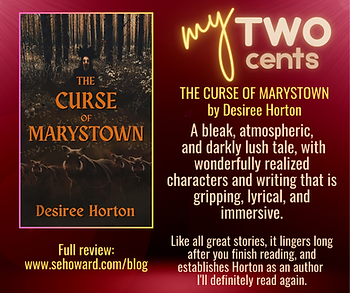
All in all, "The Curse of Marystown" is a bleak, atmospheric, and darkly lush tale, with wonderfully realized characters and writing that is gripping, lyrical, and immersive. Like all great stories, it lingers long after you finish reading, and establishes Horton as an author I'll definitely read again.
You can find "The Curse of Marystown" here.



Comments