
My Two Cents: LEVIATHAN (manga series) by Shiro Kuroi

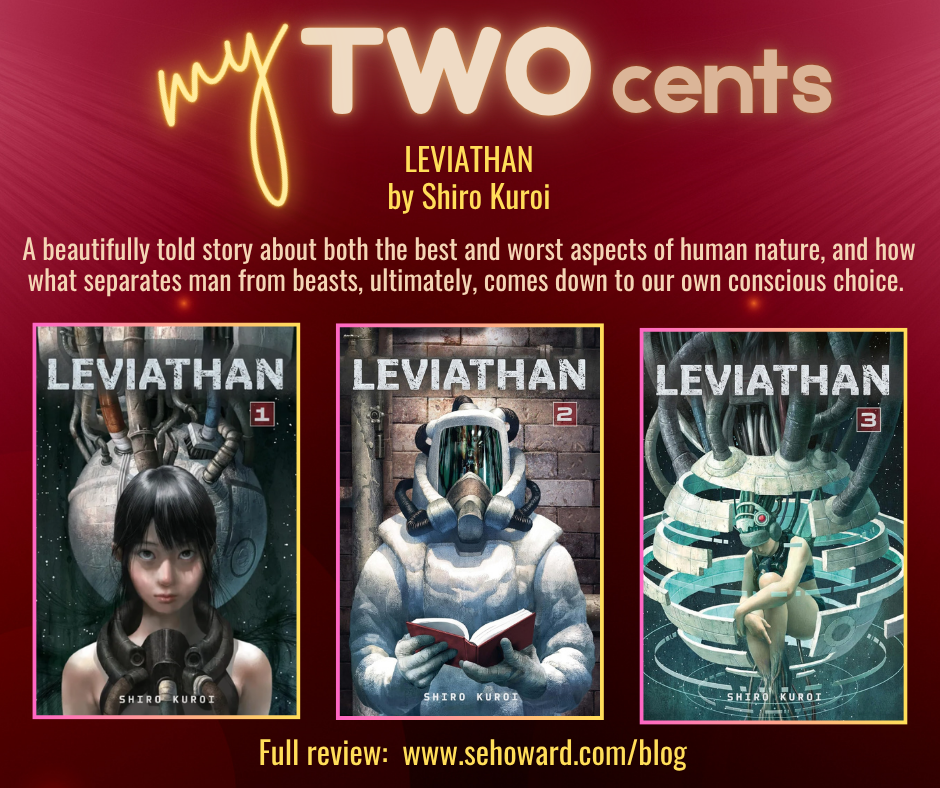
In a not-so-distant future a group of middle-schoolers on a school field trip find themselves stranded and alone, fending for themselves, when the spaceship they're traveling aboard is struck by a meteor shower. That's the set up for the three-volume manga series "Leviathan" by author/artist Shiro Kuroi. As the story opens, a crew of deep space scavengers board the derelict remains of the "Leviathan," an expansive spaceship (that literally looks like a cruise ship) that years earlier, had vanished without a trace while transporting a group of school children. The ship's discovery portends a lucrative reward for the scavengers, who eagerly board the vessel, expecting to find loot, or at the very least, an explanation for the ship's mysterious disappearance.
What they find instead is a mysterious journal written by one of the ill-fated schoolchildren, a boy named Kazuma. In his diary, he details the final days aboard the "Leviathan," and the horrific sequence of events that led to the deaths of nearly everyone on board.
I say "nearly" everyone, because as it turns out, the ship came equipped with a single cryosleep container, a chamber that could put an occupant into a cryogenically frozen hibernation to await rescue. The damage the "Leviathan" suffered in the meteor shower otherwise left the passengers with only a day or two of oxygen; after that, they would all suffocate. Because the cryosleep chamber could only hold one person, the survivors all turned against each other in a violent, bloody battle to see which one would claim it and live.
Kazuma learns about the chamber by accident when he and another classmate, a girl named Futaba, overhear their teacher discussing it with a shipboard concierge robot. When the teacher discovers their trespass, he tries to strangle Futaba to keep the location secret, so he can use it for himself. Futaba fights back, killing the teacher in the process, and from there, the battle for survival is on. Their classmates soon discover the truth about the ship's waning oxygen supply, as well as the cryochamber. They dissolve into opposing factions, arming themselves with any weapons they can make or find, and fight each other to the death. Friends become enemies, and Kazuma quickly learns there's no one in whom he can depend or trust -- not even himself.
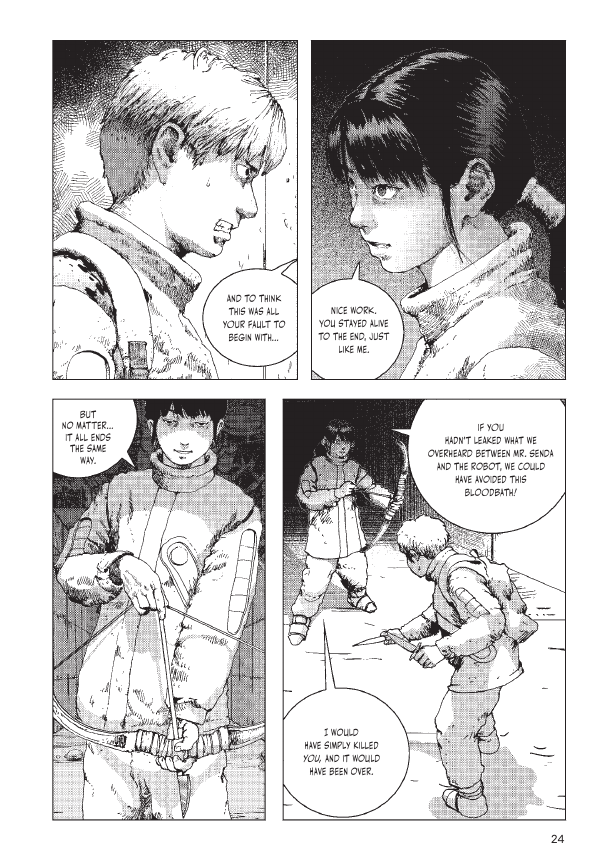
"Leviathan" is a bleak and brutal series. Think "Lord of the Flies," but set in space, and it touches on many of the same themes as William Golding's classic novel. There's the contrast between faction leaders: one brutal, nearly beast-like, the other cunning and more "civilized," and the targeting of the weakest, most timid among their numbers. The line between human being and monster quickly grows blurred, then vanishes altogether. Who makes it to the very end, and who the scavengers find asleep inside the cryochamber, is both a mystery and a surprise, both to the characters and the reader.
Kuroi's story unfolds at a steady pace, offering just enough set up into the dystopian world in which these children live to establish the opening atmosphere. From there, the tension ratchets up with every page and each panel, as suspicions grow between erstwhile friends and neighbors, and childhood innocence is quickly, brutally eroded.
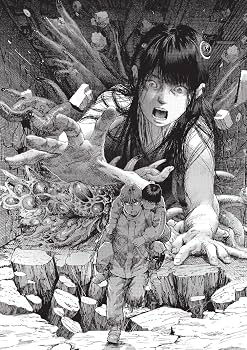
The artwork reminded me in many ways of Tsutomu Nihei's "Blame!" series, at least as far as the backgrounds within the ship itself, filled with vast, shadow-draped networks of corridors, conduits, and mysterious mechanisms. The uniforms worn by the characters, too, are reminiscent of Nihei's designs, at least those from "Knights of Sedonia" or "Kaina of the Great Snow Sea." Kuroi's characters themselves are more detailed than Nihei's, but then again, Nihei is an architect at heart, so his settings are undoubtedly his passion. And while sometimes Kuroi's characters seem over-simplified, even cartoonish, in their rendering, it's done to emphasize their innocence, and remind readers that these are children, not adults or even teenagers, dealing with a very brutal, harsh reality. When Kuroi wants to, he presents beautiful sketches with exquisite detail, especially of the girl, Futaba, who quickly proves to be the diary author, Kazuma's arch nemesis.
"Leviathan" is a series of three tankobon, or volumes. It's a completed story arc, so you're not left hanging in the end, waiting for the next installment to be released as an English translation. It's gory in places, and the subject matter is dark, but Kuroi finds a way to bring the story around full circle in the end, leaving the reader with a sense of hope in much the same way Cormac McCarthy does in "The Road."
Long story short: "Leviathan" isn't anything you haven't seen before, but it's still a beautifully told story about both the best and worst aspects of human nature, and how what separates man from beasts, ultimately, comes down to our own conscious choice.
"Leviathan" is available here.


Comments